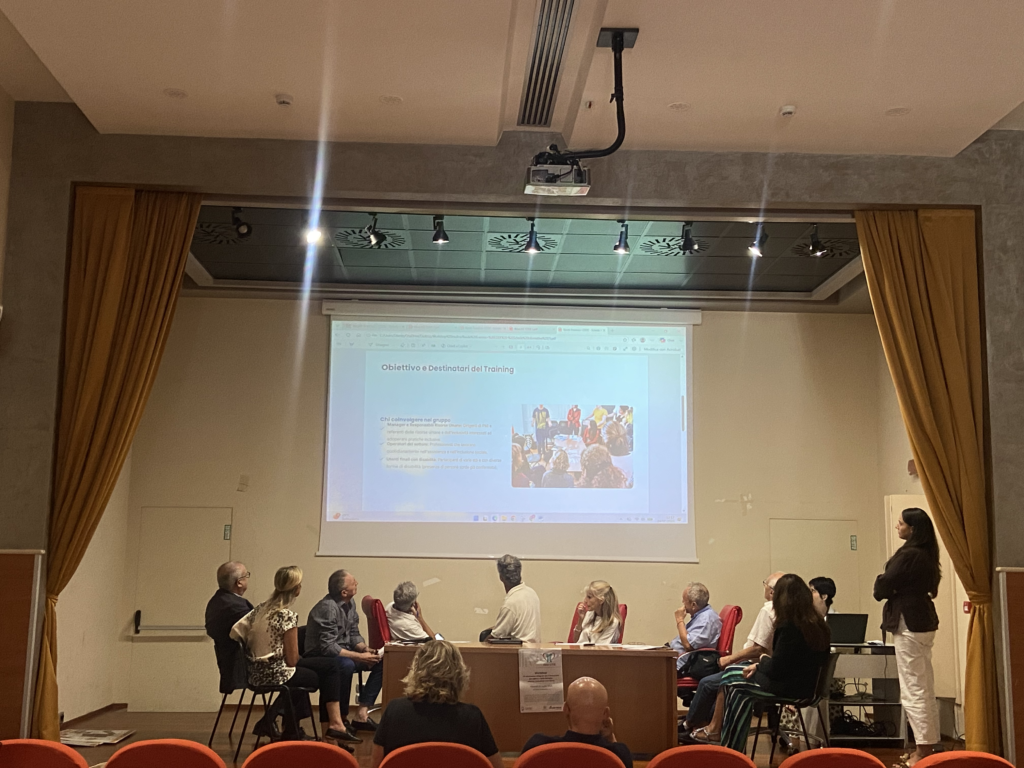

On Friday, July 24, the workshop for the INsu-LINE project aimed at stakeholders was held at the Don Orione Institute in Naples, titled “An integrated ecosystem for the well-being of young people and families: science, inclusion, and territory.” The Institute provides personalised rehabilitation for children and adults with physical, cognitive, and neurodevelopmental disabilities through outpatient, day-care, and home-based services. Beyond rehabilitation, it serves as an important community resource for families, offering social, educational, and recreational activities that promote inclusion, wellbeing, and participation.
The event involved everal local organizations that are very active in the community, such as the association “Mamme Aut”, il Tulipano, a social cooperative founded in 2007 to provide services and activities for and with People with Autism and their Families, as well as Life Plans aimed at Independence and the Enhancement of Skills and Functionality, inspired by the principles of the Quality of Life model; Circolo Ilva, located west of the city of Naples, at the foot of the Posillipo hill and overlooking the Gulf of Pozzuoli, it is a place for sports, culture, solidarity, and leisure; Città della Scienza, Italy’s first interactive museum, a place for experimentation, meeting, and dialogue between science and technology; Fondazione Aillaud for the promotion and recovery of traditional moral values, the promotion of culture, charity, and the creation of facilities for the care and protection of animals and/or suffering people; Salute in Collina, a solidarity healthcare project that, thanks to a specialist polyclinic and a network of affiliated professionals, provides quality specialist healthcare, psychological, social-health, and social-care services with short waiting times, to ensure that Insu-LINE community was broadened to maximise impact.
The workshop opened with introductory greetings from Federico II University (UNINA) Professor Guido Iaccarino, scientific director of the project. Vincenzo De Luca, UNINA researcher, illustrated the transition towards community medicine and digital health, highlighting how technology enables continuity of care, monitoring, therapeutic adherence, and prevention in people’s daily lives. Dr. De Luca presented the structure of the INsu-LINE predictive algorithm, developed to identify the risk of cardiovascular events in patients with type 2 diabetes through the cleaning, harmonization, and analysis of clinical data and Machine Learning models, with the goal of guiding personalized care pathways.
UNINA Professor Maddalena Illario presented the Impact Acceleration Program of the INsu-LINE project, developed within the framework of the DARE – Digital Lifelong Prevention Innovation Ecosystem. The program serves as the operational tool of Work Package 5 to support the objectives of communication, stakeholder engagement, adoption, and scalability of solutions. The initiative is structured into three implementation lines called “Inclusive Communities and Community Well-being,” “Healthy Ageing and Active Communities,” and “Health Literacy, Evidence, and Legacy,” with the goal of collecting data for impact monitoring and fostering health and digital literacy.
UNINA Professor Cristina Mele addressed the theme of knowledge enhancement and the role of UNINA Third Mission. In her presentation, she outlined the concept of a socially oriented university (“engaged university”) and the institution’s role as an “innomediary” and network orchestrator, capable of connecting research with businesses, institutions, and local communities to facilitate innovative processes and the co-creation of value.
The session continued with the panel discussion “Community actors as accelerating elements for health,” aimed at presenting the WP5 stakeholders: Città della Scienza, Fondazione Aillaud, Associazione Il Tulipano, Istituto Don Orione, Salute in Collina, Associazione Mamme Aut and Circolo Ilva. The discussion then focused on the vulnerability of patients and their families, particularly in the context of general practice and children with special needs. The need for a more human and less bureaucratic approach to care was highlighted, emphasizing the challenges general practitioners face with a growing number of patients and a lack of resources.
Each stakeholder presented their contribution in support of families and special children, offering opportunities for training, culture, and social integration. The proposal was to create a support community—involving various institutions and associations—to address daily challenges and promote inclusion. The underlying idea is to build dedicated pathways for both children and parents, including recreational and digital literacy activities with a lasting impact, addressing needs through innovative approaches and multidisciplinary, multi-stakeholders collaborative interventions.